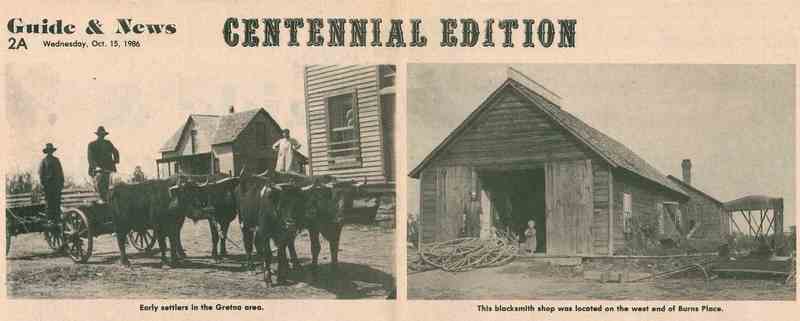
Gretna was founded when pioneers settled in the area in the 1870s to farm the land and raise animals. In the heart of the village was the Burlington Railroad, which drew people away from nearby villages, including Melia and Forest City. The community started with a general store, a hardware/implement store, a blacksmith shop and a saloon as the only businesses.
Gretna Public Schools started as a one-room schoolhouse about a mile outside of the village, just north of where the LaBorde Cemetery still is today. Between 1887 and 1889, the growing community decided to move the school into town, where it stood across Angus Street, directly facing St. Patrick’s Catholic Church.
“Downstairs, there was a teacher for first and second grade, third and fourth grade had another teacher in another room. Fifth and sixth grade had another teacher, and seventh and eighth grade,” said Anna Proctor, one of the oldest citizens of Gretna. She graduated from GHS in 1948.
In the following years, the school added an upstairs, doubling the size in 1908. Soon after, in 1910, a 12th grade was added, filling out a full high school education opportunity. In that time, the village continued to grow by adding new buildings and businesses, like a drug store and a bank. By 1913, the population of Gretna was sitting at 475 people.
Gretna entered a rest period from about 1915 to 1930. The town continued to grow through new businesses and people moving in, but everything slowed down compared to before, and the exponential growth stopped. And that’s where the growth of Gretna completely stopped, and that’s where we are today, right? Wrong.
In 1931, the US Highway 6 moved from going straight through Gretna to where it is today, which is just west of downtown Gretna. Instead of just staying the same and not taking advantage of the highway, the town capitalized on the movement and moved with it, making the town now centered around the highway.
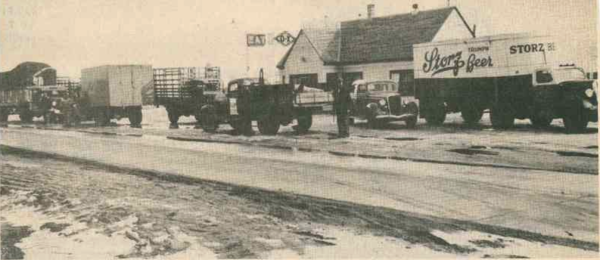
Major growth was brought into the community, whether it be new businesses, new activities at the school or just new experiences in general.
“We had a town hall, and that’s where we, in the later years, and that’s where we went to the Bohemian Dances,” Proctor said. “And that’s where I met my husband. He and his buddies would come; they were always together, and they would come to the dances. That was a good night.”
Change continued when Highway 370 rolled through town, bringing even more people through Gretna around 1961. This type of growth has continued to this day, not only because of those main roads, but because of the proximity to both Omaha and Lincoln.
“The city starts with SIDs (Sanitary and Improvement Districts), and I think the first one of size for us was Plum Creek, then Chestnut Ridge, then Lincoln Place, Tiburon, and as those developed, the town grew,” former GPS Superintendent Kevin Riley said.
Gretna is nowhere near the same as it was when it was founded over 150 years ago, or even 40 years ago. When English teacher Jennifer Long was a student here in Gretna in the 80s and 90s, class sizes were smaller, everything was smaller and it just felt different.
“In the English department, we all had the same teacher because that teacher was only teaching that class,” Long said. “If you taught freshmen, that’s what you taught, so we all had the same 4-5 teachers.”
Today, most people choose to focus on one sport or one activity and roll with it all through high school. There’s almost no way that a student can do more because most activities follow a year-long schedule, whether it’s weight lifting and agility training in the off-season or in-season games and practices. With fewer people involved when Long was in high school, it was normal to be in a variety of extracurricular activities.
“I did speech, one-act, show choir, cheerleading and journalism,” Long said. “The coaches were expected to make that possible (to be in multiple activities). That was a very clear, widely known expectation.”
As Gretna slowly expands its reach, whether it’s into Millard, Elkhorn, Papillion or Omaha, being from Gretna is slowly losing its meaning. Developments are where people identify themselves, and “Gretna” is turning into a broad term, not a place.
“I feel like we lose connection to the community when a lot of our experiences are pushed into the suburbs,” Long said. “Research tells us that there’s just not always a lot of identity connection to the suburbs, and so when Gretna was a really small town, we all just lived in Gretna. But now people say, ‘Oh, I live in Tiburon or Plum Creek’ and it just loses this connectivity that makes people have a loyalty and sort of a protective nature around each other and around their town.”
Growth changes things. That’s very evident. Cities change, towns change, friends change and relationships change. Sometimes change is for the better, sometimes it’s for the worse. There’s a coffe shop on almost every corner in Gretna, it seems like. There also used to be an old library that was a gas station too. You don’t see that in big cities. That sense of transformation is something that long-time city members and residents can see and relate to very clearly.
“Everybody knew each other back then, and that’s all changed now,” Riley said. “And that’s just how it is, that’s what happens with growth. It happened in Omaha. It happened in Bellevue. It happened in Papillion. It happened in Elkhorn. It’s happening in Bennington. As you grow, that’s what changes.”
Without some of these key traits of a small town, the small town claim is slowly falling apart. We are also nowhere near the size of Omaha or even Millard, so we can’t claim to be a city.
So what are we?