
Welcome to Gretna, Nebraska: population of 9,207. Located right outside of Omaha, we have the joys of the big city being in our backyard while at the same time being completely surrounded by corn and bean fields on our borders.
Life here does not conform to the stereotype of a small town as seen in movies, yet we aren’t anywhere close to what life is like in the city. If you decide to stay in town for the weekend during the fall, many head to Vala’s Pumpkin Patch, one of the most developed and extravagant pumpkin patches in the country. On that sort of Saturday, however, traffic on Highway 6 can be backed up for about a mile as people head to Lincoln for the football and volleyball games . . . and sometimes even both. These teams are huge points of pride for any town or city in Nebraska, knowing that we have some of the best athletics in the country.
Friday (or Thursday, in some cases) night lights for football here in Gretna are a different experience, especially when it’s time for the rivalry game with Gretna East. Two different teams in Gretna made a huge impact on our unity; yet, when either team makes it to a state championship, you know there will be students from the other schools still cheering them on.
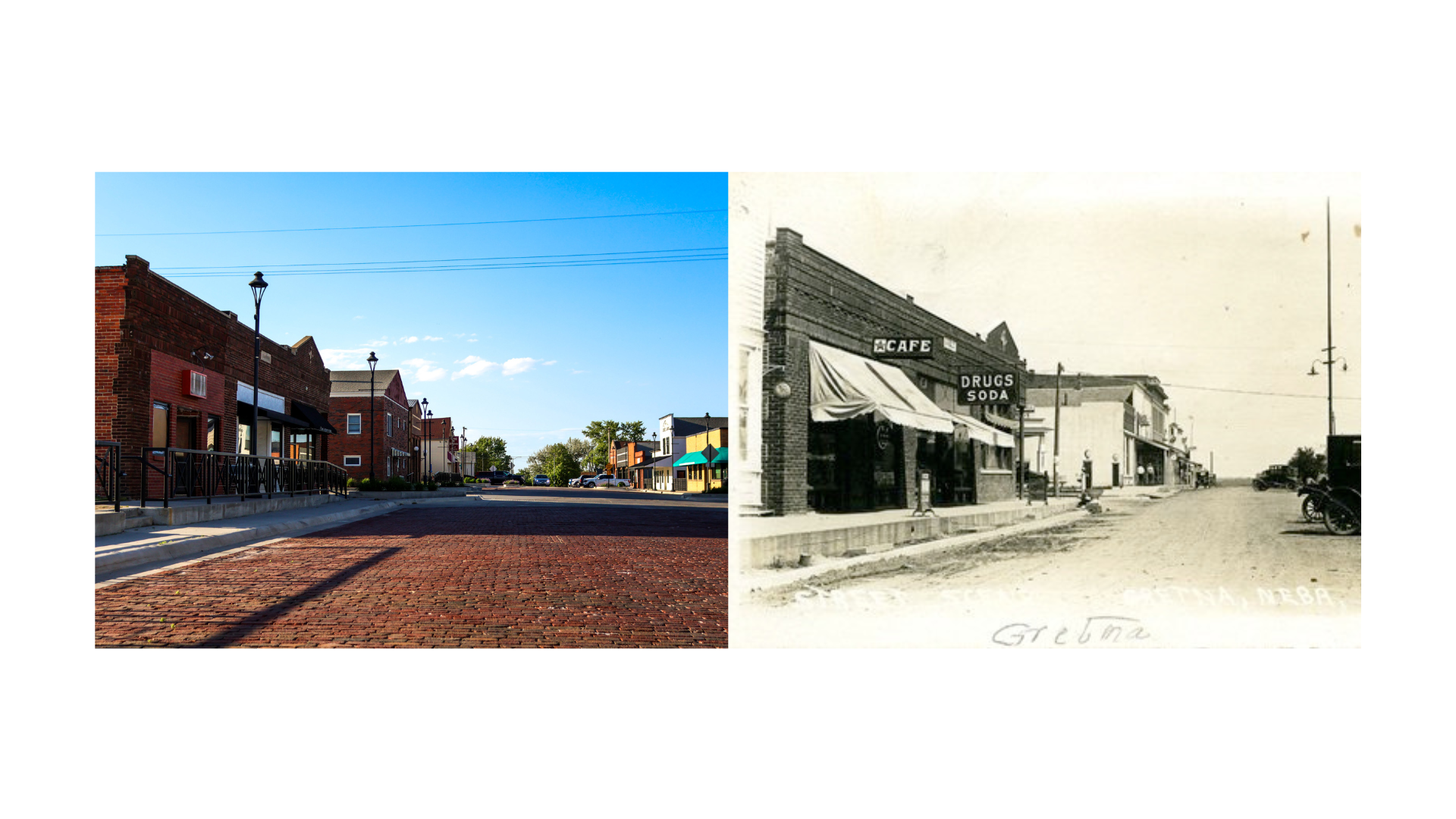
Downtown Gretna is gradually becoming more and more business-friendly once again. The farmer’s market, which runs from June until early October 4, has become a new favorite for many citizens. Whether it’s the fresh produce and food truck smells wafting through the air or all the family fun activities offered by different organizations in the community, going to the market has become a new tradition for many. What was once just a brick road really only used for Gretna Day’s festivities is now filled with so much more and draws small businesses back. Some of the newer businesses on McKenna Avenue include the Candle House, Kathy’s Bar and Grill (which replaced Brag N’ Rights) and the most recently opened Wander + Wonder Kids Play Cafe.
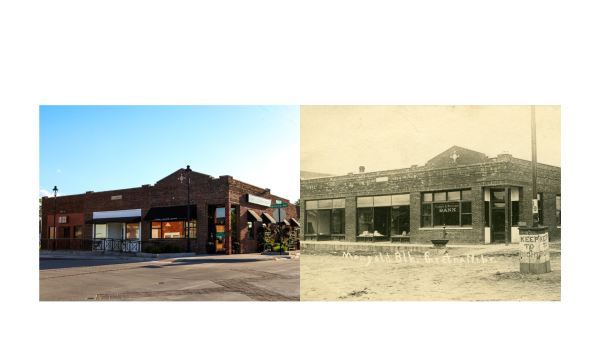
The Town and Country Floral building shop has not always been a florist shop. In the mid 1900s, it was one of the many banks in town. (Courtesy of Mary Jane Kushiner and Rolland Mangold/Gretna Public Library)Gretna has always been considered a small town, but, as times change, so does Gretna . . . especially with the schools. What started decades ago with two buildings, an elementary school (K-6) and a middle and high school (7-12), has branched into eight elementary schools, three middle schools and two high schools. The 2023 opening of Gretna East was the most significant change of all. Sports play an even larger role in the community’s unity than many people realize. With two schools came two different teams, and students who used to be friends were separated and taught to disdain anyone who attended the other school because it had become a “rivalry.” This rivalry extends beyond football as well. Almost all sports and competitive activities are part of the competition between schools. The only exceptions are swimming and bowling, which have combined GHS and GEHS teams.
Gretna is a place that is actually bigger than what meets the eye. The city limits stretch from 144th Street to 221st Street and from Meadows Boulevard down to Platteview Road. The school district boundaries extend even farther, encompassing F Street, 150th Street, Highway 31 and the point where west 288th Street would be if it were to continue south. Because of this, Gretna technically expands into areas that many people consider part of Elkhorn, Millard, Papillion and Omaha.
With this proximity to the city and other suburbs, though, it begs the question: “So why are we not more like them?” This question can be taken in many different ways.
At GHS, there are only two real tracks for high school education. The standard curriculum classes are offered by the high school, as well as ones that are supposed to prepare and give students a head start for college. These “head start” classes are dual credit (DC) courses, where students get both high school and college credit for completion, which are taken through Metropolitan Community College (MCC) here in the Omaha area.
Unfortunately, though, students who plan to attend out-of-state schools can have trouble getting these credits to transfer exactly how they wish. For example, a science credit as a science credit may not perfectly work out because not all colleges or universities have a well-established relationship with MCC. Some will accept a DC class as elective credits, but it’s not guaranteed. On the other hand, MCC credits transfer well to regional colleges and universities because of those established relationships.
Meanwhile, at Elkhorn High School and Millard West High School, both conveniently less than 10 miles away, they offer the widely-known Advanced Placement (AP) classes. These classes are on the same level of difficulty as the DC classes offered here in Gretna, but their impact, it can be argued, goes much farther. The AP program is a nationwide initiative. In those AP courses, however, students often need to take a high-stakes exam and score well to receive college credit.
Diversity is another topic. Even though Gretna Public Schools accepts anyone into the district, no matter any personal characteristics they may have, Gretna is still a predominantly Caucasian school district. Drive just 20 minutes into the city, and the picture changes. Omaha Public Schools and Millard Public Schools both have a much larger population of immigrants and people of various races and ethnicities than we see here in Gretna. While Gretna may be growing in buildings and the general population, big gains in diversity that come with growth cannot be seen … yet.
Job opportunities are very different here, too. While some people stay in Gretna to work, the majority of career opportunities that are near us are in West Omaha or downtown. Some people even drive to Lincoln every day. Gretna’s largest job pool mostly consists of jobs that teenagers can work, whether it’s being a cashier at the Nebraska Crossing Outlet Mall to running the counter at a fast food restaurant. While Gretna grows, different work sectors will expand into the area, but Gretna isn’t quite there . . . yet.
Comparing the history of Gretna and what the plans for the future look like blurs the line between small town and city life. We claim to be a small town, but it’s very evident that we are leaning away from that in several different areas.
So what are we?