Most people drive through small Midwest towns without thinking twice, their minds on the destination. For a recent Gretna High School graduate, those quiet places hold stories waiting to be told.
Bella Yungtum, now a freshman of the University of Kansas, has developed a unique style of photography that blends portraits, abandoned spaces and stories of the people who live among them. Her work feels mysterious and slightly unsettling, which is exactly what draws viewers in.
Yungtum first became interested in photography in sixth grade after learning from a neighbor who worked as a professional photographer. One early experience helped shape the direction her own work would eventually take.
“She took me to my first abandoned house when I was in sixth grade,” Yungtum said, “It was like the coolest thing that I had ever seen.”
From there, her curiosity grew. As soon as she was old enough to drive, she began seeking interesting locations of her own.
“Pretty much as soon as I could drive by myself, I started hunting down places,” Yungtum said.
Over time, her photography interests have evolved. She experimented with wildlife and nature photography before eventually finding herself drawn to rural spaces, abandoned buildings and the people connected to them.
“It’s really easy to take a pretty picture of something that’s already beautiful,” Yungtum said. “Like a bald eagle or a deer. That’s not a hard thing to photograph.”
Instead, she prefers a greater challenge.
“It’s challenging to take something that’s molding and decaying and make it beautiful,” Yungtum said.
One of her most memorable experiences happened unexpectedly while driving through a small rural town with her mom after a college orientation trip. The town has only a few hundred residents and can be driven through in just a few minutes.
After begging her mom to pull over and explore, the two stopped by an abandoned church on the side of the road and were approached by an elderly man, named Jack, who lived nearby.
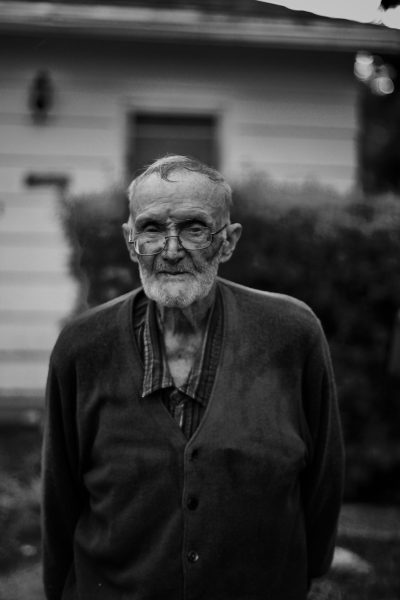
“He just started talking about how he lives all by himself,” Yungtum said. “He was around 94 years old, and he told me he had lived in that town his whole life.”
The conversation left an impression on her and changed how she approached photography.
“That was the first time I really talked to a subject before taking pictures.” Yungtum said. “I started to love the idea of photographing people like that.”
Now, when she photographs people, she looks to learn more about their lives before capturing their portraits or the spaces connected to their stories. In one instance, she knocked on the door of a house that appeared uninhabited from the outside. Inside lived an elderly man who was the last member of his family.
“He told me nobody ever knocks on his door,” Yungtum said. “He just wanted to talk.”
Experiences like that are what continue to motivate her work. She said she believes photography can reveal stories that might otherwise go unnoticed.
“I feel like that’s part of communities that sometimes get overlooked,” Yungtum said, referring to older residents in rural towns.
Her willingness to approach strangers has also helped shape her photography. While some photographers prefer planned shoots, many of her most meaningful photos happen spontaneously.
While on a trip to Colorado, Yungtum noticed a young girl hiking with her parents.
“I was like, ‘Oh my gosh, your daughter is so pretty. Can I take a portrait of her?’” Yungtum said.
The girl’s parents agreed, and the quick interaction turned into one of her favorite portraits. Moments like that require confidence and a willingness to talk to people she has never met before.
“It can be a little intimidating,” Yungtum said. “Sometimes I’ll walk by a person three times trying to work up the courage to ask if I can take their picture.”
Not everyone says yes, but she has learned to accept that as part of the process.
“Sometimes people just say, ‘No, thank you,’ and you just move on,” Yungtum said.
Still, she said she believes the risk is worth it, because those conversations often lead to meaningful photographs and unexpected stories.
Even in everyday life, photography shapes how she sees the world. Simple moments and ordinary details can quickly become potential images.
“I could just see the way water hits a shower wall, and I’d think ‘That would be a cool picture,’” Yungtum said.
Because of that mindset, road trips often take longer than expected.
“A three-hour drive usually takes me about four and a half because I stop every time I see something cool,” Yungtum said.
Although many people today have access to cameras through their phones, she believes photography is about more than simply snapping a picture.
“Everyone has a camera now,” Yungtum said. “But just because you have a camera doesn’t mean the pictures you take are effectively telling what you’re trying to say.”
For her, the real challenge is finding meaning within an image.
“Taking a picture of something should make you feel something or want to know the story behind it,” Yungtum said.
Her goal is to capture details that others might overlook and turn them into images that tell a story.
“In a world where everyone takes pictures, you have to find something different,” Yungtum said. “You have to find beauty in places that people usually overlook.”
As Yungtum continues studying in college, she is still exploring what the future might hold for her photography.
“I don’t know exactly what I want to do with it yet,” Yungtum said. “But I know I love it.”
For now, she continues documenting the stories she encounters, one photo at a time.