
Over the winter months and holiday season, the metropolitan community and most people in cities have the comfort of a warm home. However, some do not experience that and instead are shivering, buried in blankets, while never getting the satisfaction of warmth, which everyone longs for and appreciates on a cold day.
Hidden within the freezing winter city are those people tend to glance at but turn away from quickly. Those we tend to put no thought into when we are bundled up cozy in our bed. Those we tend to donate our extra food or unused items to, but never give our time to, genuinely help.
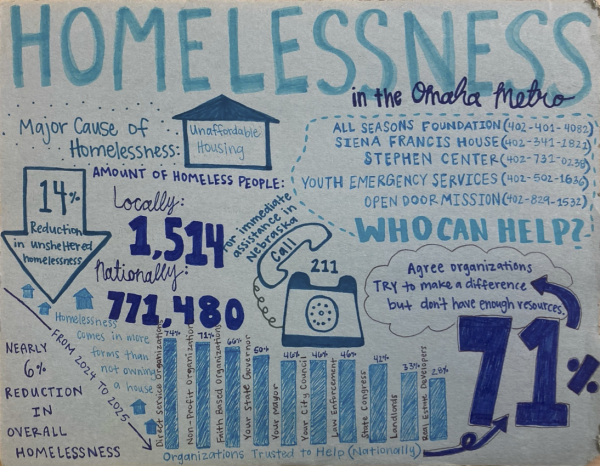
Within the country’s cities are growing numbers of homeless people scattered around. Within the United States, more than 771,480 people suffered from homelessness in 2024. Just down the road, 1,514 people are struggling with this problem in Omaha, according to the 2024 annual census.
In an article by The National Alliance to End Homelessness, it states, “More people (118,376) did not have a home in 2024 than in 2023.” With such a large number of homeless people around, and in some areas continuing to grow, there has to be a potential solution somewhere.
There is no easy solution to bring this issue to an end, but there are ways to reduce it. Having access to special needs services, having more treatment facilities and having more affordable housing are things that can help. The lack of these things can keep people on the streets.
“The various experiences, the various needs, the various levels of barriers,” saidTamara Dwyer, the city of Omaha’s Homeless Service coordinator. “There is never the same situation for anyone; it’s always different.” However, there are many people across the metro area who are helping with all the different situations. There are many food ministry organizations such as Heartland Hope Mission, Food Bank of The Heartland and, even more locally, the Gretna Food Pantry. An organization in downtown Omaha, Table Grace Cafe, does its food ministry a little differently.
Table Grace Cafe, created by the Weber family, is located near 16th and Franam streets. It is a food ministry that charges the bare minimum for hot meals and accepts free-will donations. This sort of two to five dollar plate helps to ensure everyone is being fed. If a person comes along and can’t afford this meal, they also have the option to work for their food instead and do jobs within the cafe.
“Instead of just a handout or providing a hand up, instead of working for people in need, we work with them. And instead of enabling the status quo, we’re empowering people to contribute to not only healthier lifestyle for themselves but contributing to the community and in the neighborhood,” owner Matt Weber said.
Weber works to create relationships with all who set foot in his cafe. With the relationships he builds, he can encourage, build habits and help people build stability in their lives once again. By doing this, he follows his mission statement of “nourishing hungry bodies and minds.”
“When you work with people in our café, the most important thing that happens is a relationship with each customer,” Weber said. “We believe healthy giving is based on healthy relationships and the only way to have a relationship with someone is if you spend time with them, work with them and that’s what we do at our café.”
The Weber family continues to want to help and build relationships, but due to how much they give and not always receive, they have to host fundraisers often. Combining Matt’s talents of cooking and Simone Weber’s musical talents, they draw attention to their ministry. That way, they try to raise money.
Just as our bodies need more than food to survive, so do those on the street. We can often take the roof over our head for granted, but despite the work some put in, they still can’t say they have one. Many organizations, such as The Siena Francis House and Carole’s House of Hope, provide temporary housing for those without a roof over their head. Other organizations, such as the Least of My Brethren, assist people on the streets and help people move off the streets into apartments.
“When we started in 2000, we started just handing out food and blankets, and over time it just grew, and we started adding coats and sleeping bags, and then after a while it began bicycles. And everything just kinda grew a little bit,” said Dave Harvey, the founder of Least on My Brethren.
Desiring to make a change, the Harvey family continued to grow their organization. On an average week, they try to move eight to ten people off the street and into apartments. With the lack of volunteers, some weeks, they are not able to provide for as many people.
With a little or a lot of volunteers, they work to help those in need. They also create relationships with those they help. As they get to know them more, they discover the reasons some are on the street. They have worked with younger girls who got pregnant and were kicked out of the house, and they have worked with trafficking victims that need help getting back on their feet. These are both reasons that don’t follow the stereotypical reasoning for homelessness.
“I think we certainly try to help those that are the most vulnerable,” Harvey said.
The city of Omaha is also working to see a change, too. They recently launched the Pilot Program. This is where people can call, or the city can notice homeless camps, and the camps will receive a 10-day notice. Within these 10 days, the city will try to house them and provide for them, but if they do not wish to seek help, their camp will be taken down after the 10 days.
“There are so many folks that really just need someone to build trust back with them. They’ve been kinda jaded or harmed in different systems that aren’t really designed very well, having to navigate them and kind of give up and a lot of hopelessness. And going through that direct housing process, we were able to give some folks hope,” Dwyer said.
Similar to the other organizations that are working to end homelessness, this pilot program is trying to build relationships. In order to convince more people to leave the comforts of the home they made for themselves on the street, they create a trusted relationship. Then, encouraging them to start over and create better habits.
People are working in the metro area and beyond to help those suffering on the streets. They are all aware they are not going to completely put this problem to an end, but even one step at a time means they are moving forward.