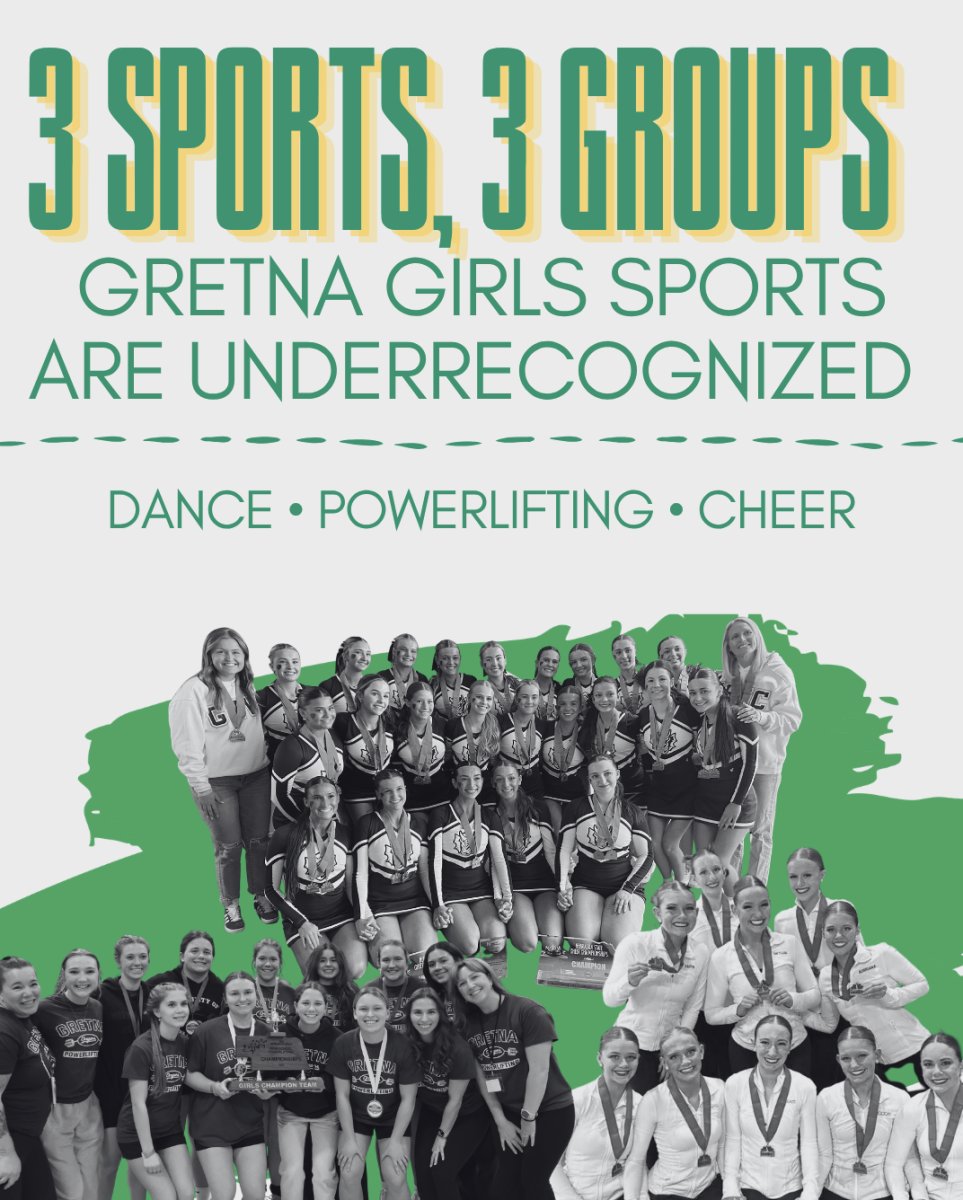
There’s prestige attached to the NSAA medals. Only placed around the neck of the strongest athletes, most talented writers and speakers, they’re known to represent the best. On Feb. 21, the girls’ powerlifting team was named state champions by the Nebraska High School Powerlifting Federation (NHSPF), but it sparked the question: what kind of doors would open if the meet was hosted by the NSAA?
With the sport’s growing popularity, the most natural next big step should be to include powerlifting in their annual state schedule. A part of that step however, needs to be working with the existing hosts, the Nebraska High School Powerlifting Federation (NHSPF), to carefully organize a tournament at the NSAA level. This should be done for the good of all high school athletes. Powerlifting is a sport that often includes people who would not otherwise compete. This would expand the opportunities to even more students everywhere.
The powerlifting “club” has always operated like a winter sport. The team practices on Monday, Wednesday and Friday, with meets most Saturdays. At this point in time, powerlifters feel robbed of athletic status, despite the physical and mental training they go through for not only their season, but year round to maintain muscle.
“We compete like any other sport. We practice, we go to competitions. We’re a team,” senior Sydney Malone said. “So, there’s no difference between, like, us and basketball.”
This is how most schools in Nebraska run their powerlifting programs, however it’s not like this at all schools. It’s not even at all schools. What’s currently lacking across the Metro, and especially outside of it, is uniformity within programs. As of now: there’s little to none. NSAA sports dictate when you can start practicing, tournament scheduling and the difference between conditioning and actual practice. Currently, every school that even has a team does it a little differently. Streamlining the “club” would unite divided programs.
Additionally, this would allow students at other schools to experience and see for themselves what’s been happening here. In Gretna alone, dozens of athletes, including a hefty number of females, participate, lift and compete during the winter months. Not only has it gotten them more involved, but their participation has also exposed most of them to athletics when they otherwise wouldn’t be. A transfer to the NSAA would increase the already exponentially-growing participation.
“I think right now, individual high schools set up their own teams, and it’s run as a club. There’s a lot of schools in Nebraska that don’t have teams, so I think that would lead to a massive spike in participation,” Head Coach Alise Pape said. “If it became an NSAA sport and all schools had teams, I can’t even fathom how big this would be, because, right now, we’re looking at just 30 schools at the state meet and over 230 athletes competing. So this could be huge.”
While Pape agrees that participation would spike for several positive reasons, she fears that the detailed planning required for this newer sport could affect the quality of a potential State event.
“Part of me really would like to see it become an NSAA sport and get that recognition, because our athletes work really hard and the sport has grown a ton in recent years,” Pape said. “Part of me is nervous to see the NSAA take it over, because I feel like powerlifting is a very niche sport and so in order for meets to run effectively you have to have people who understand it, and I just don’t know how many people there are at the NSAA who have a history in powerlifting or a background in powerlifting, so I feel like I have mixed emotions about it.”
Pape is a founder and current member of the NHSPF, the group that has hosted a state powerlifting meet for several years. This year marked the first fully unified state meet, as other federations have hosted a “state” meet in years past. The 2026 championships, as well as every year before it, were run by this group with integrity at the forefront of their minds.
“Right now, each meet director staffs their own meet, so we ask people to come ref those and volunteer. So all the people we ask to volunteer are former powerlifters themselves, they have competed so they have experience in this sport,” Pape said. “Where I would be nervous, like I don’t know if the NSAA has the ability to staff meets that way.”
In order to both recognize powerlifters in Nebraska as varsity athletes, as well as maintain a quality experience throughout their seasons, the NSAA should work with the current federation to establish powerlifting as an NSAA sport. A slow, careful transition would also be the easiest process in securing quality seasons, and in turn the benefits that come with NSAA ties.
“I’ve had athletes even in the past write to the NSAA about wanting it to be taken up as a sport,” Pape said. These students have never been responded to. “A huge piece of that I think for athletes the motivation is the recognition for things like lettering, for example.”
Students and powerlifting state medalists within this year’s champion program, like Malone and junior Andie Yost, hope to see powerlifting be taken up. Currently, powerlifters don’t qualify as varsity athletes, nor do they letter in it, which would be useful in applying for colleges and/or scholarships.
“If we were recognized by the NSAA, we’d get NSAA medals, better awards, better scholarships,” Malone said. “We’d be noticed more by colleges and scouts, as opposed to kind of being a club that’s just there.”
This staff editorial reflects the opinions of the online media staff of Dragons’ Tale.